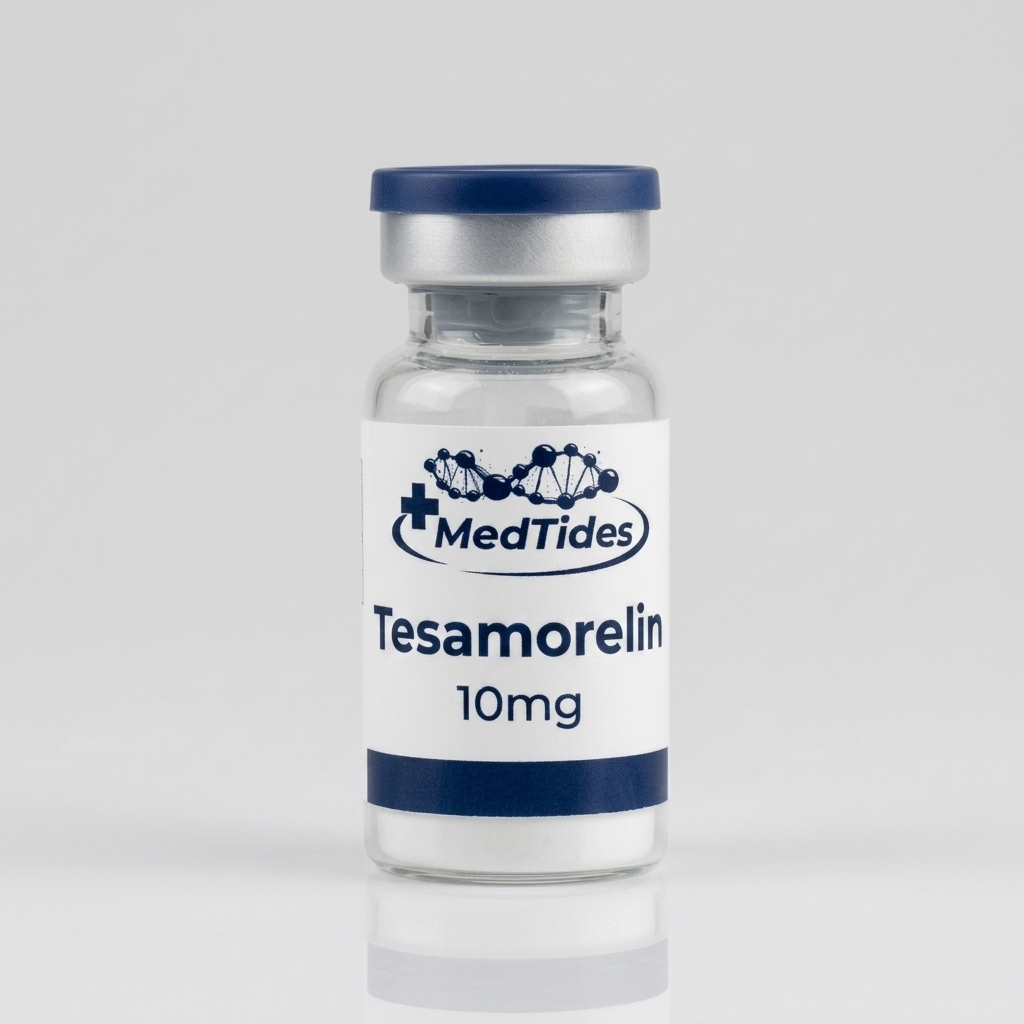
CAS: 218949-48-5 · Trans-3-hexenoic acid N-terminal modification
What Is Tesamorelin?
Tesamorelin is a synthetic analogue of human growth hormone-releasing hormone (GHRH), consisting of all 44 amino acids of native GHRH(1-44) with a trans-3-hexenoic acid modification at the N-terminus. This modification protects the peptide from dipeptidyl peptidase-IV (DPP-IV) cleavage, extending its biological half-life compared to native GHRH [1].
Unlike exogenous growth hormone (GH), tesamorelin doesn't directly bind the GH receptor. Instead, it stimulates the pituitary gland's own somatotroph cells to produce and release endogenous GH in a pulsatile pattern — mimicking the body's natural secretion rhythm. This distinction is mechanistically important and represents a fundamentally different approach to GH-axis research [2].
How Does It Work? — Mechanism of Action
Tesamorelin binds to GHRH receptors (GHRHR) on anterior pituitary somatotroph cells, activating a well-characterized signaling cascade:
- GHRHR binding → Gαs protein activation → adenylyl cyclase stimulation
- cAMP increase → protein kinase A (PKA) activation
- Ca²⁺ influx through voltage-gated calcium channels
- GH vesicle exocytosis — release of stored GH granules
- GH gene transcription — increased long-term GH production [3]
Why Pulsatile Release Matters
Natural GH secretion is pulsatile — large bursts every 3-5 hours, with the largest pulse occurring during slow-wave sleep. This pulsatile pattern is not just an artifact; it's functionally important. Studies have shown that continuous vs. pulsatile GH exposure activates different downstream gene expression patterns in target tissues [4].
Tesamorelin preserves this pulsatile pattern because it works through the natural GHRH receptor rather than directly providing exogenous GH. This is its key mechanistic advantage in research contexts.
Tesamorelin vs. Exogenous GH — Key Differences
| Parameter | Tesamorelin | Exogenous GH (191aa) |
|---|---|---|
| Mechanism | GHRH receptor agonist → endogenous GH release | Direct GH receptor activation |
| GH Pattern | Pulsatile (physiological) | Supraphysiological, non-pulsatile |
| Feedback Preserved | Yes — somatostatin feedback intact | No — bypasses HPG axis |
| IGF-1 Elevation | Moderate, within physiological range | Dose-dependent, can be supraphysiological |
| FDA Status | Approved (Egrifta® — specific indication) | Approved (multiple indications) |
| Molecular Weight | 5,135.9 g/mol (44 AA) | 22,124 g/mol (191 AA) |
Clinical Trial Data
Tesamorelin has one of the strongest clinical datasets of any research peptide, with multiple completed Phase 3 trials:
The Pivotal Trials
Two Phase 3 randomized, double-blind, placebo-controlled trials enrolled over 800 patients total. Key findings:
- Significant reduction in visceral adipose tissue (VAT) measured by CT scan — the primary endpoint in both trials [5]
- IGF-1 levels increased to within normal physiological range without exceeding upper limits in most subjects
- Lipid profile improvements — triglyceride reduction and changes in total cholesterol ratios [6]
- GH feedback mechanisms remained intact throughout the treatment period
Long-Term Extension Studies
A 26-week extension study showed that the VAT reduction was maintained with continued treatment but reversed upon discontinuation — indicating the compound's effects are dependent on ongoing GHRH receptor stimulation rather than permanent tissue remodeling [7].
Clinical context: Tesamorelin is FDA-approved as Egrifta® for the reduction of excess abdominal fat in HIV-infected patients with lipodystrophy. This is its only approved indication. All other uses remain investigational.
Current Research Areas
Beyond its approved indication, tesamorelin is being actively studied in several research contexts:
Cognitive Function Research
A notable study published by Baker et al. investigated tesamorelin's effects in adults with mild cognitive impairment (MCI) and healthy older adults. The 20-week trial found improvements in certain cognitive measures compared to placebo, potentially mediated by IGF-1's known neuroprotective signaling [8]. This has opened a new research direction exploring the GH-IGF-1 axis in neurodegeneration.
Metabolic Pathway Studies
In-vitro studies continue to explore tesamorelin's effects on hepatic lipid metabolism, insulin sensitivity markers, and adipocyte differentiation. The compound's ability to raise GH without disrupting the somatostatin feedback loop makes it uniquely useful in studies requiring physiological GH elevation [9].
Cardiovascular Biomarkers
Post-hoc analyses from the Phase 3 trials identified potentially favorable changes in cardiovascular risk biomarkers, including C-reactive protein and carotid intima-media thickness. These findings are preliminary but have generated interest in the GHRH-GH-IGF-1 axis as a modulator of vascular health [10].
Important Limitations
Despite its strong clinical dataset, several important caveats apply:
- Effects are reversible — VAT reduction reverses within weeks of discontinuation
- Single approved indication — FDA approval is limited to HIV-associated lipodystrophy only
- IGF-1 monitoring required — sustained IGF-1 elevation above reference ranges has theoretical long-term concerns
- Pituitary dependency — requires functional somatotroph cells; ineffective in patients with pituitary damage or prior radiation
- Not interchangeable with GH — different mechanism, different downstream effects, different clinical profile
The Bottom Line
Tesamorelin occupies a unique position in peptide research. It has genuine clinical validation (Phase 3 trials, FDA approval), a well-characterized mechanism, and preserves physiological GH secretion patterns. For researchers studying the GH-IGF-1 axis, it offers something that exogenous GH cannot: a way to stimulate endogenous GH release while keeping the somatostatin feedback loop intact.
The growing interest in its cognitive and cardiovascular effects suggests we'll see more clinical data in the coming years. For now, it remains one of the few research peptides that bridges the gap between preclinical science and clinical evidence.
Sources
- Ionescu, M. & Bhargava, R. (2008). "Tesamorelin: a synthetic growth hormone-releasing factor analogue." Expert Opinion on Biological Therapy, 8(5), 691-696. PubMed: 18407770
- Veldhuis, J.D. (2008). "Pulsatile hormone secretion — mechanisms, significance, and evaluation." Ultradian Rhythms from Molecules to Mind, Springer. PubMed: 18600380
- Mayo, K.E. et al. (2000). "Regulation of the pituitary somatotroph cell by GHRH and its receptor." Recent Progress in Hormone Research, 55, 237-266. PubMed: 11036939
- Jansson, J.O. et al. (1985). "Sexual dimorphism in the control of growth hormone secretion." Endocrine Reviews, 6(2), 128-150. PubMed: 2861084
- Falutz, J. et al. (2007). "Metabolic effects of a growth hormone-releasing factor in patients with HIV." NEJM, 357, 2359-2370. PubMed: 18057338
- Stanley, T.L. et al. (2014). "Effects of tesamorelin on non-alcoholic fatty liver disease." Gut, 63(7), 1169-1177. PubMed: 24277732
- Falutz, J. et al. (2010). "Long-term effects of tesamorelin on visceral fat and metabolic parameters." AIDS, 24(13), 2009-2017. PubMed: 20616694
- Baker, L.D. et al. (2012). "Effects of growth hormone-releasing hormone on cognitive function in adults with mild cognitive impairment." Archives of Neurology, 69(11), 1420-1429. PubMed: 22911048
- Makimura, H. et al. (2012). "The effects of tesamorelin on hepatic lipid content and liver enzymes." JCEM, 97(11), 4134-4143. PubMed: 22942384
- Lo, J. et al. (2016). "Tesamorelin effects on markers of cardiovascular risk." JAIDS, 71(3), 256-262. PubMed: 26473793