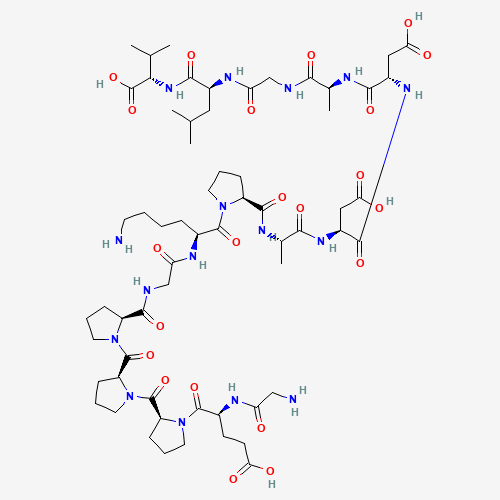
BPC-157
Pentadecapeptide
TB-500
Thymosin Beta-4 Fragment
| Property | BPC-157 | TB-500 |
|---|---|---|
| Category | Pentadecapeptide | Thymosin Beta-4 Fragment |
| Formula | C₆₂H₉₈N₁₆O₂₂ | C212H350N56O78S |
| Molecular Weight | 1,419.53 g/mol | 4,963.44 g/mol |
| Published Studies | 120+ | 80+ |
| Clinical Status | Preclinical Research Only | Preclinical Research |
| Overview | A 15-amino-acid gastric peptide extensively studied in preclinical models for FAK-paxillin pathway interactions and NO system modulation. | A 43-amino-acid peptide studied for actin-binding protein interactions and cellular migration in wound healing models. |
BPC-157 — Key Details
What Is BPC-157?
Body Protection Compound-157 is a synthetic 15-amino-acid peptide derived from a protein in human gastric juice. First characterized by Prof. Predrag Sikiric (University of Zagreb) in the 1990s, it has over 120 published papers — primarily from one research group.
Investigated Pathways
- FAK-paxillin pathway — cell adhesion and structural integrity signaling
- Nitric oxide (NO) system — vasodilation, inflammation, and cellular communication
- Growth factors — VEGF, EGF, FGF receptor interactions
- Dopaminergic/GABAergic systems — central nervous system signaling
Important Limitations
All published data comes from in-vitro and animal studies. No completed human clinical trials exist. The majority of research originates from a single lab, which limits independent validation. In 2023, the FDA flagged BPC-157 for increased regulatory scrutiny. It is not approved for any therapeutic use.
Sources
- According to Sikiric, P. et al. (2018). "Stable gastric pentadecapeptide BPC 157 and wound healing." Frontiers in Pharmacology, 9, 1446. [PubMed]
- According to Sikiric, P. et al. (2023). "BPC 157 and the nitric oxide system." Pharmaceuticals, 16(5), 768. [PubMed]
- According to Vukojevic, J. et al. (2022). "BPC 157 and tendon healing." J Orthopaedic Surgery and Research, 17, 235. [PubMed]
TB-500 — Key Details
What Is TB-500?
TB-500 is a synthetic version of Thymosin Beta-4, a 43-amino-acid peptide first isolated from the thymus gland. It plays a central role in actin polymerization.
Mechanism of Action
TB-500 binds to G-actin monomers, regulating actin filament assembly critical for cell motility. The active region is LKKTETQ.
Investigated Applications
- Cell migration in wound scratch assays
- Actin polymerization via G-actin sequestration
- Inflammatory modulation via NF-kB pathway
- Angiogenesis via VEGF upregulation
Not FDA-approved. Banned by WADA. Preclinical data only.
Sources
- According to Goldstein, A.L. et al. (2012). "Thymosin beta4: multi-functional regenerative peptide." Expert Opin Biol Ther. [PubMed]